
Directions:
To formulate your answer to the questions below you must use the resources provided for you in this course (lectures, primary sources, American Yawp). Failure to do so will affect your grade accordingly. Address one of the questions below.
Question(s):
- What role did race theories play in the development of the West and U.S. expansion beyond North American borders?
- How did the failures and successes of Reconstruction influence American behavior in Cuba, Hawaii, and the Philippines?
- How did race, gender, imperialism, and public opinion intersect in the United States during the turn-of-the-century?
- How did Indigenous Americans and foreigners experiencing US expansion counter American intervention?
- How did industrialization relate to American expansion West, into the Pacific, and Latin America?
- How did US racial biases against “new immigrants” relate to racial biases against Cubans, Filipinos, and Hawaiians?
- How did the Spanish-American war cartoons (below) reflect the reality (or not) of the United States’ participation in the Spanish-Cuban-Filipino-American War?
Primary Sources
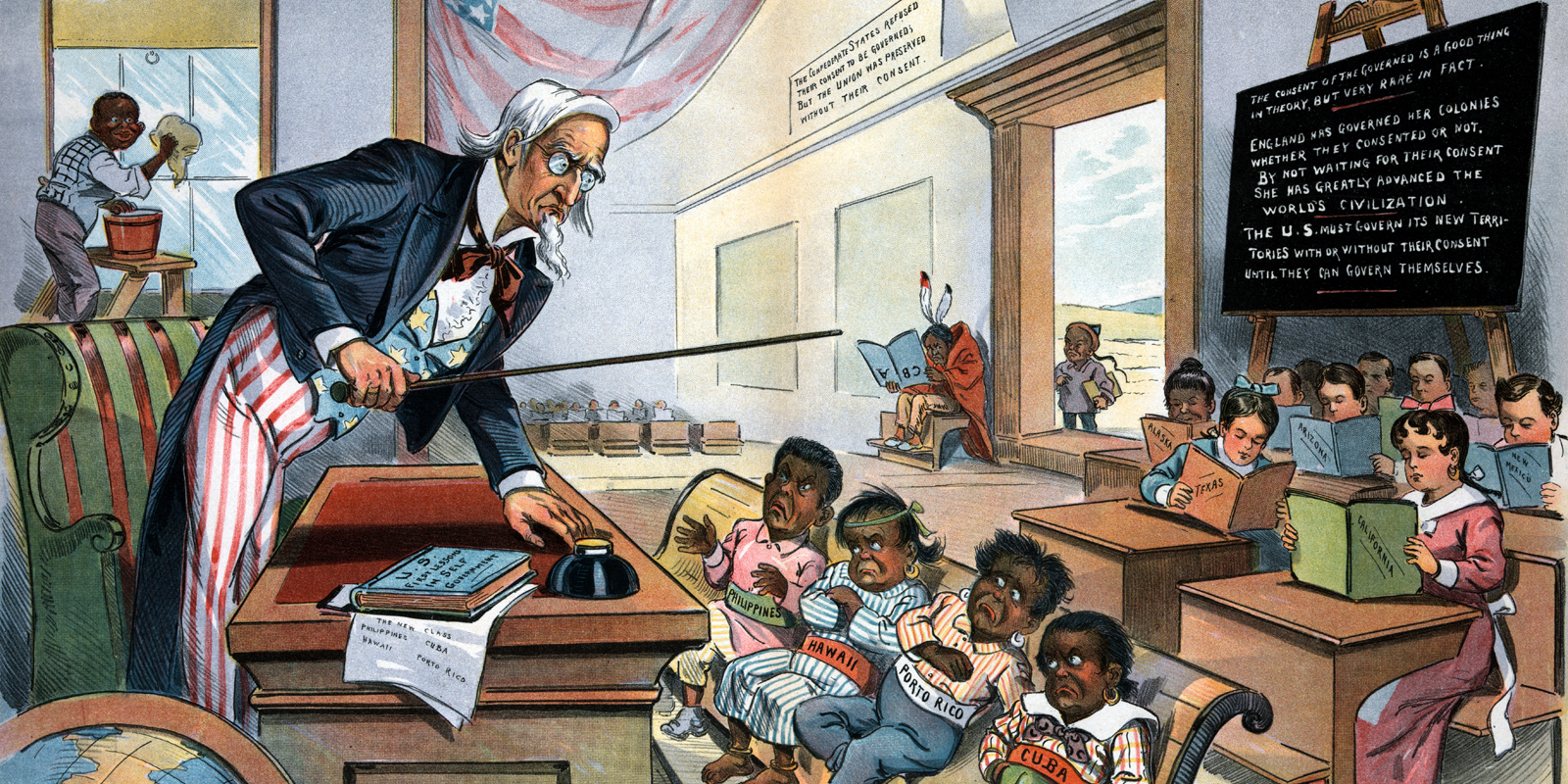
A political cartoon in Puck magazine on January 25, 1899, captures the mind-set of American imperialists. .
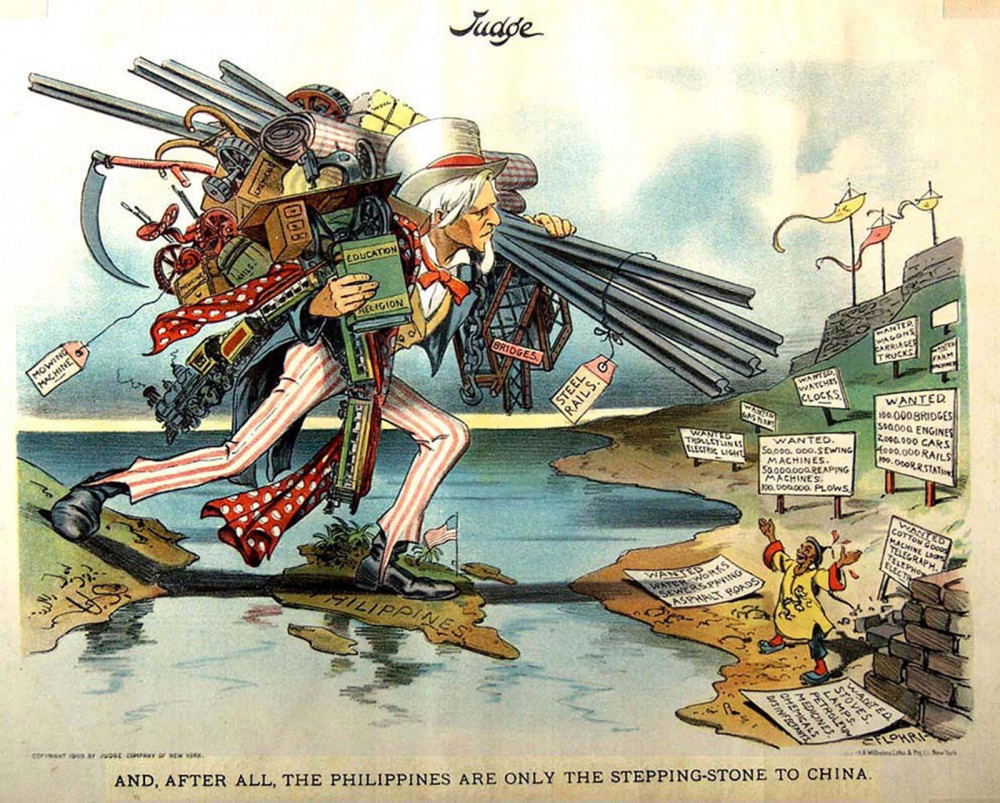
In this political cartoon, Uncle Sam, loaded with the implements of modern civilization, uses the Philippines as a stepping-stone to cross the Pacific to China, which excitedly awaits Sams arrival. Such cartoons captured Americans growing infatuation with imperialist and expansionist policies. C. 19001902. .
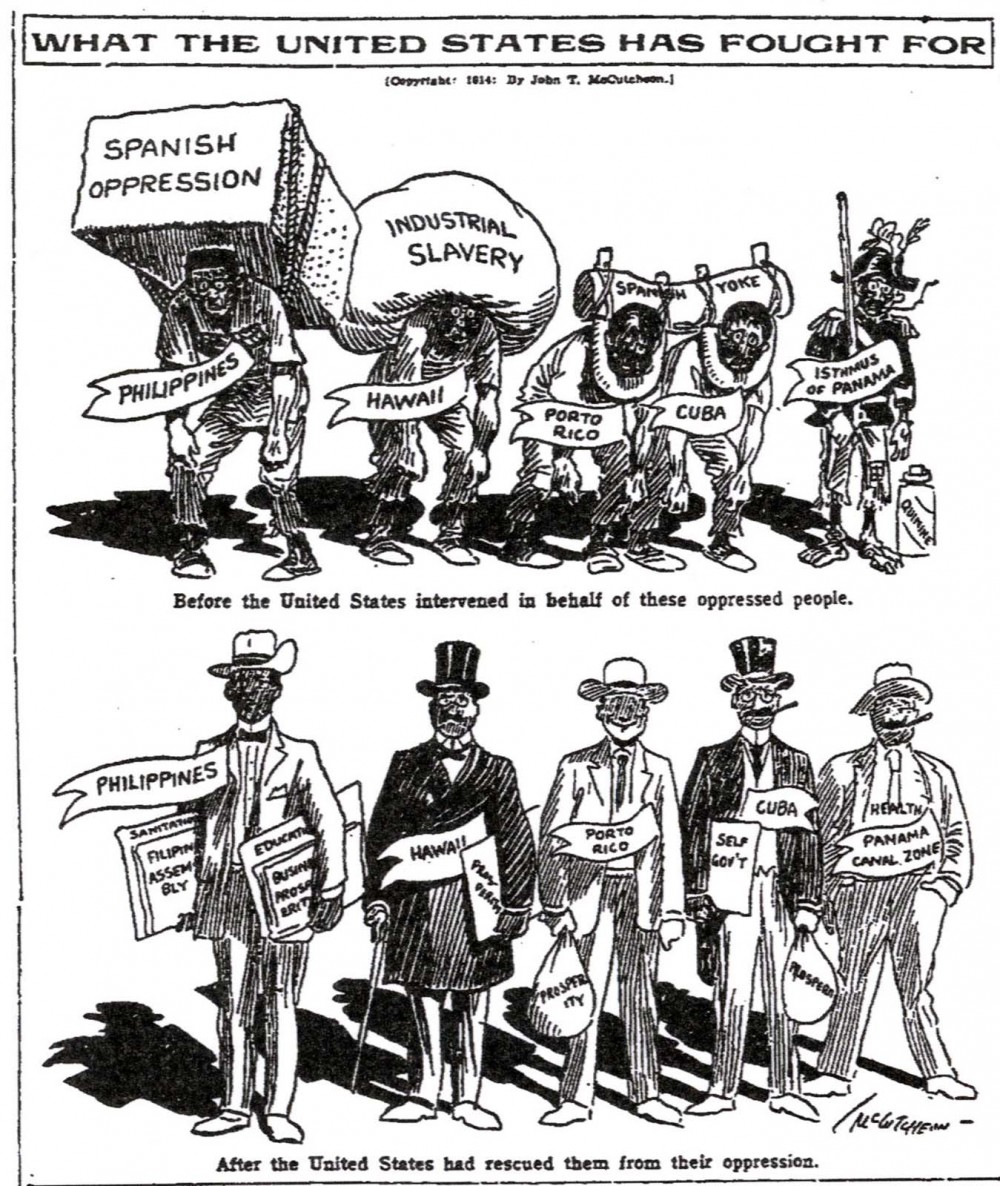
This 1914 political cartoon shows embodiments of colonies and territories before and after American interventions. The differences are obvious and exaggerated, with the top figures described as oppressed by the weight of industrial slavery until America rescued them, turning them into the respectable and successful businessmen seen on the bottom half. Those who claimed that American imperialism brought civilization and prosperity to destitute peoples used such visuals to support their cause. .
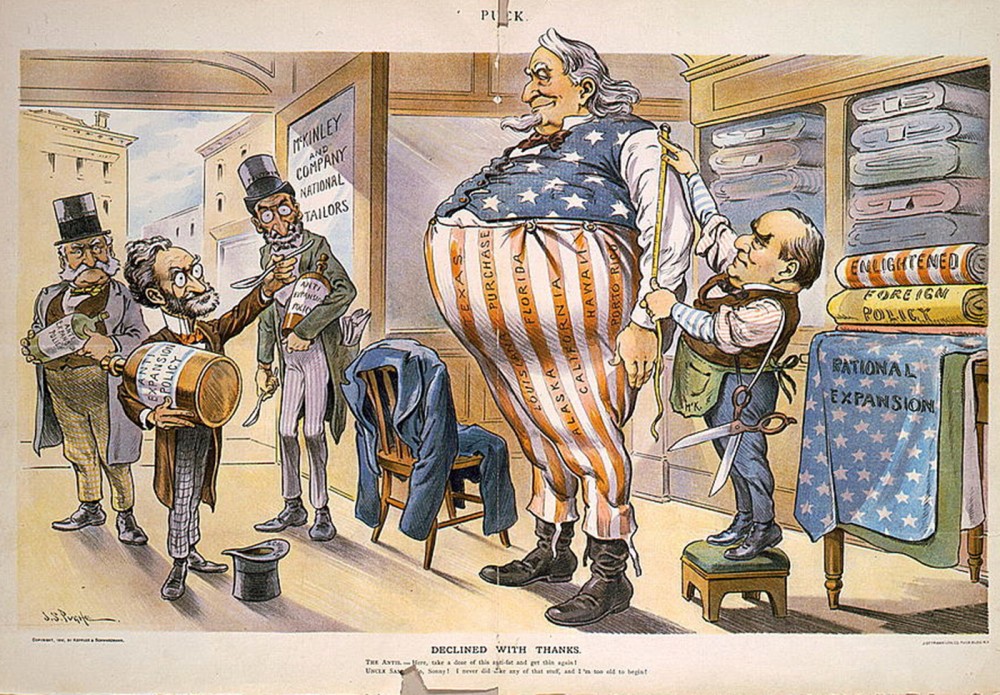
In this 1900 political cartoon, President McKinley measures an obese Uncle Sam for larger clothing, while anti-expansionists like Joseph Pulitzer unsuccessfully offer him a weight-loss elixir. As the nation increased its imperialistic presence and mission, many worried that America would grow too big for its own good. .
Detailed Directions
Weekly Critical Reflections: Read the prompt carefully to understand what your reader expects. Before you begin to address the prompt you should have viewed the video-lecture and read the secondary and (at least two) primary sources and annotate/highlight the information or examples that will help you prove your main idea to the prompt.
- As you write your weekly critical reviews you should keep in mind these two objectives: 1) read analytically and think critically; and 2) improve how you explain what you are observing and how you rationalize what is happening in the readings (that is, you are working on the improvement of your written communication skills).
- With these purposes in mind you will 1) analytically read historical material(s) to answer specific prompt questions, and 2) write a clear and strong comment as a reply to these questions.
- You accomplish the above objectives and proposes by efficiently writing: 1) you need a clear topic sentence or main idea, 2) you need to provide evidence and examples (at least two) from the readings that support your topic sentences, and 3) you must finish with a concluding sentence.
- The topic sentence of your WCR should be a direct answer to one or more of the prompts question(s). It should be only one sentence. If it is more than one sentence then it is not a topic sentence or main idea.
- In the next six or seven sentences you most support your main idea with the evidence you have annotated/highlighted from your reading of the materials. I strongly encourage you to explain this information and the examples you select in your own words. Do not quote from the materials unless you believe the authors words cannot be expressed better in other words. If you quote, you have to cite the source (author and or title of primary source is sufficient).
- In the last sentence of your comment, you reaffirm the main idea you have offered in your topic sentence. This is your conclusion.
- You accomplish the above objectives and proposes by efficiently writing: 1) you need a clear topic sentence or main idea, 2) you need to provide evidence and examples (at least two) from the readings that support your topic sentences, and 3) you must finish with a concluding sentence.
- With these purposes in mind you will 1) analytically read historical material(s) to answer specific prompt questions, and 2) write a clear and strong comment as a reply to these questions.
- Assessment: My reading of your WCR will assess whether your submission demonstrates 1) you understand the prompt and assigned materials; and 2) your ability to organize your ideas and the evidence you have collected in a strong paragraph (topic sentence, evidence, and conclusion).
References:
Be sure to introduce your source and also include a reference citation.Use documentation format.
